
 English
 Deutsch
 العربية
 فارسی
فارسی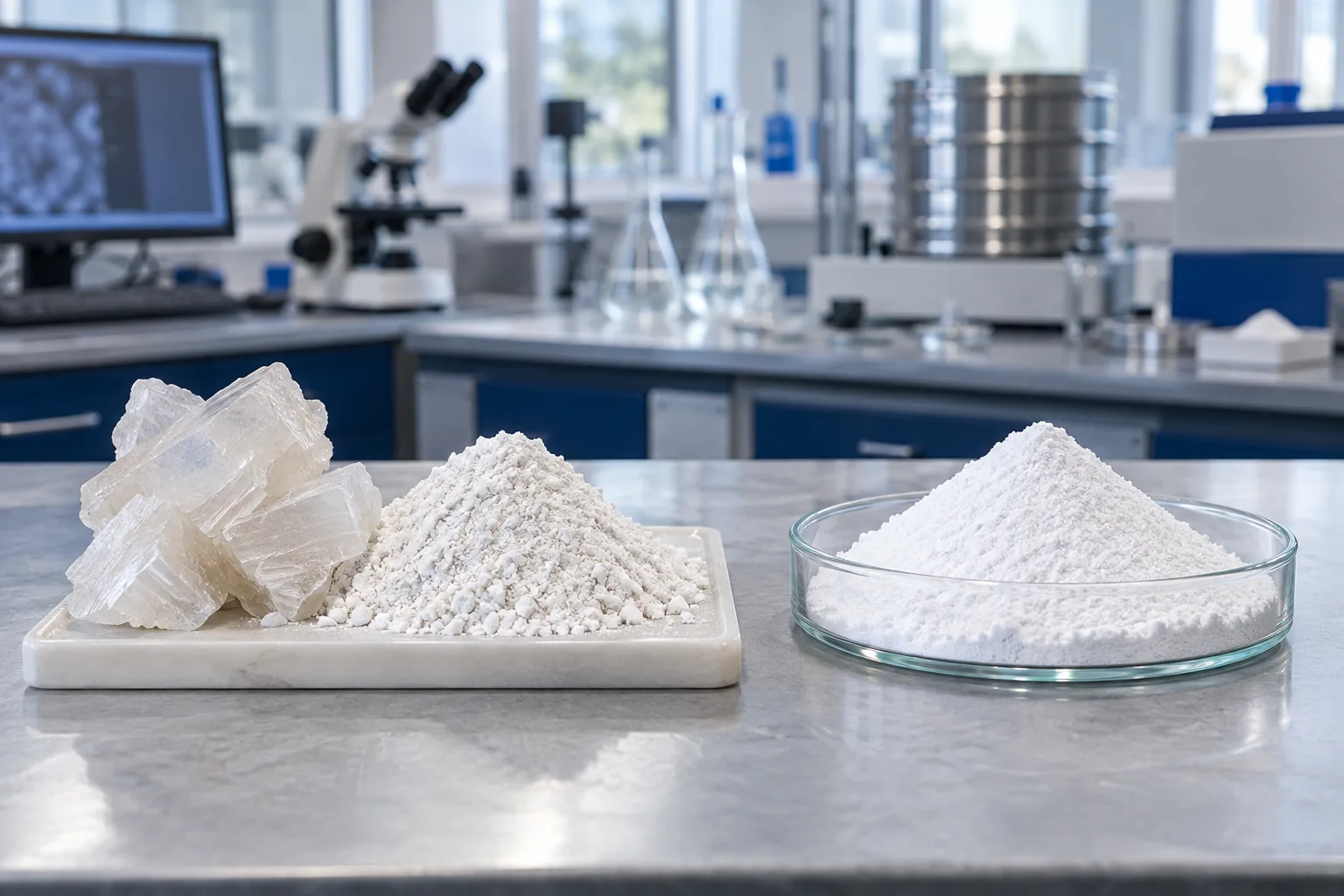
The short answer
White crystal barite is natural barium sulfate. It is mined, selected, processed and micronized. Precipitated barium sulfate is produced through a controlled chemical precipitation process. It is also called synthetic barium sulfate or blanc fixe.
These materials share the same main chemical compound, but they are not automatically interchangeable. Particle size, particle shape, whiteness, impurities, oil absorption and batch consistency can affect the result in a formulation.
How are natural and precipitated barium sulfate different?
| Point | Premium natural white barite | Precipitated barium sulfate |
|---|---|---|
| Origin | Selected natural barite ore | Chemically precipitated material |
| Production | Beneficiation, milling and classification | Controlled chemical reaction and precipitation |
| Particle character | Crystalline mineral particles | Particles formed during precipitation |
| Consistency | Depends on deposit selection and process control | Usually controlled through the chemical process |
| Purchase decision | Compare the TDS, sample and final formulation | Compare grade-specific data and final formulation |
| Economics | Can offer better raw-material economics in suitable uses | Normally includes additional chemical-processing steps |
“Precipitated,” “synthetic” and “chemical” barium sulfate usually describe the same broad product family. Commercial grades can still differ in particle size, surface treatment and intended application.
What does KANIPER Premium White Barite offer?
KANIPER Premium White Barite is a micronized natural crystalline grade. According to its current technical data sheet, it has at least 97.5% BaSO4, whiteness 90, a D50 of 2.3 µm and a D98 of 9 µm. Its oil absorption is 10–15 g/100 g and its specific gravity is 4.25–4.40 g/cm³.
These figures make it a relevant candidate for buyers who need a fine, white and dense functional filler but do not automatically require a synthetic precipitated grade. The potential saving comes from using a high-quality natural mineral instead of paying for additional chemical manufacture. The actual commercial result also depends on freight, order size, processing and the approved dosage.
Review the Premium White Barite TDS before testing. A TDS supports selection, but it does not replace a trial in the buyer’s own formulation.
Where can it be considered?
- Decorative and industrial paints and coatings
- Powder coatings
- Engineered plastics and premium masterbatch
- Rubber compounds
- Adhesives, sealants and mastics
- Specialty paper and technical filler applications
Natural premium barite should not be presented as a universal one-for-one replacement. A synthetic surface-treated or tightly controlled specialty grade may remain necessary when the formulation has exceptional optical, purity or processing requirements.
For applications with less demanding whiteness or particle-size requirements, buyers can also review KANIPER Industrial White Barite.
A simple replacement checklist
- Define the required whiteness, particle size, oil absorption and impurity limits.
- Compare the current synthetic grade with the KANIPER TDS.
- Test both materials at the same starting dosage.
- Check dispersion, colour, gloss, viscosity, surface finish and settling.
- Run a pilot batch before approving regular production.
- Fix the accepted specification in the purchase order.
For a sample or a technical discussion, contact KANIPER and state the application and the property that matters most.
References
- ISO 3262-2:2023, Extenders — Specifications and methods of test — Part 2: Baryte (natural barium sulfate).
- ASTM D602, Standard Specification for Barium Sulfate Pigments.
- KANIPER Premium White Barite Technical Data Sheet, model KA.BA03.
Would you like to test premium white barite in your formulation?
Send your application, required properties, annual demand and destination. KANIPER can provide the current TDS and discuss a representative sample.
Contact KANIPER