
 English
 Deutsch
 العربية
 فارسی
فارسی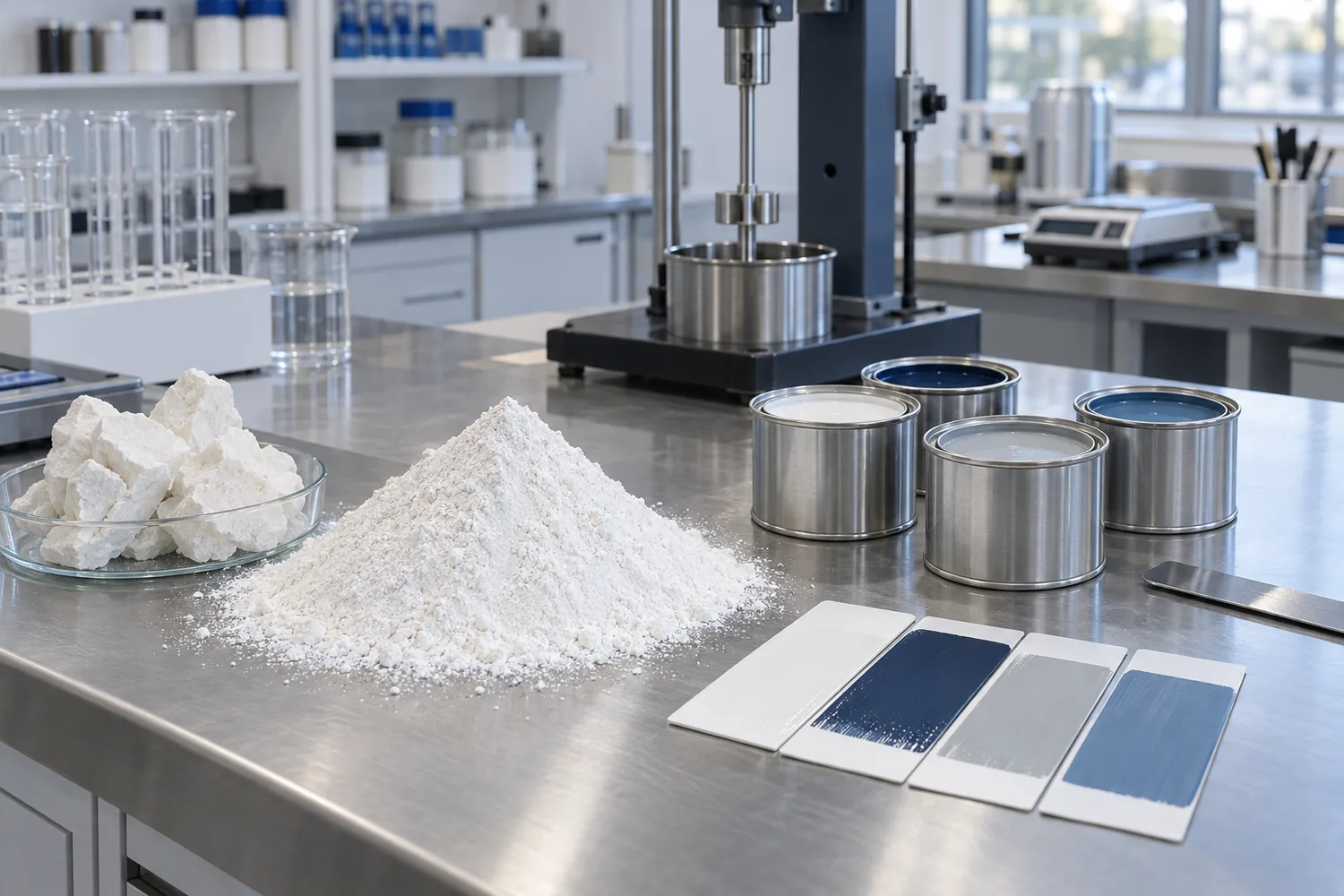
The quick answer
Barite is natural barium sulfate. In paint and coating formulations it can be used as an extender or functional filler. It can add body and density while supporting a smooth, stable film when the grade is suitable for the system.
Not every barite powder is a coating grade. Buyers should check whiteness and undertone, particle-size distribution, coarse residue, oil absorption, moisture, soluble impurities and dispersion. The final decision should come from a formulation trial.
What does barite do in a coating?
- Provides mineral body: it occupies volume in the dry film and can support the required solids balance.
- Adds density: its high specific gravity can be useful where film weight or density matters.
- Supports surface finish: a controlled fine grade can help produce a more uniform surface.
- Offers chemical stability: barium sulfate is valued as a stable mineral component in many formulations.
- Helps formulation economics: a suitable natural grade can be an efficient functional filler, but performance must be confirmed before changing the recipe.
The result also depends on the resin, pigments, additives, grinding process and application method. A property stated on a TDS does not guarantee the same behaviour in every paint.
Which KANIPER grade should a buyer consider?
| Application need | Starting option | What to verify |
|---|---|---|
| Industrial primers and coloured coatings | Industrial White Barite | Particle size, undertone, coarse residue and dispersion |
| White or light-coloured coatings | Premium White Barite | Whiteness, colour consistency, oil absorption and surface finish |
| Powder coatings | Fine industrial or premium grade | Particle distribution, flow, finish and compatibility with the complete system |
| Highly demanding optical or specialty coating | Compare natural premium barite with the incumbent specialty filler | Side-by-side laboratory and pilot results |
For the difference between premium natural material and synthetic material, read White Crystal Barite vs Precipitated Barium Sulfate.
What should buyers check?
Whiteness and undertone
Brightness alone is not enough. Two powders can show a similar value but create a different visual result. Compare a representative sample in the intended colour system.
Particle size and coarse residue
Mesh names provide only a basic description. For sensitive coatings, request the particle-size distribution and the test method. Coarse particles can affect finish and filtration.
Oil absorption and dispersion
Oil absorption helps the formulator estimate binder demand. Dispersion should be checked in the actual resin and production process. Watch for agglomerates, settling and unexpected viscosity changes.
Moisture and batch consistency
Stable incoming quality makes production control easier. Define the approved specification and compare the sample, TDS and shipment COA against the same grade.
Simple trial checklist
- State whether the product is for a primer, liquid coating or powder coating.
- Share the target colour and surface finish.
- Review the current filler specification and acceptance limits.
- Test a representative barite sample at a controlled starting dosage.
- Compare colour, viscosity, dispersion, settling, gloss and film appearance.
- Run a pilot batch before routine purchasing.
- Record the approved grade and test methods in the purchase specification.
To request current documents or a representative sample, use the KANIPER contact page.
References
- ISO 3262-2:2023, Extenders — Specifications and methods of test — Part 2: Baryte (natural barium sulfate).
- USGS Minerals Yearbook: Barite, industrial uses and particle-size requirements.
- KANIPER Industrial White Barite and Premium White Barite technical data sheets.
Need a barite sample for a coating trial?
Send the coating type, target colour, particle-size requirement, annual demand and destination. KANIPER can discuss the suitable industrial or premium white grade.
Contact KANIPER