
 English
 Deutsch
 العربية
 فارسی
فارسی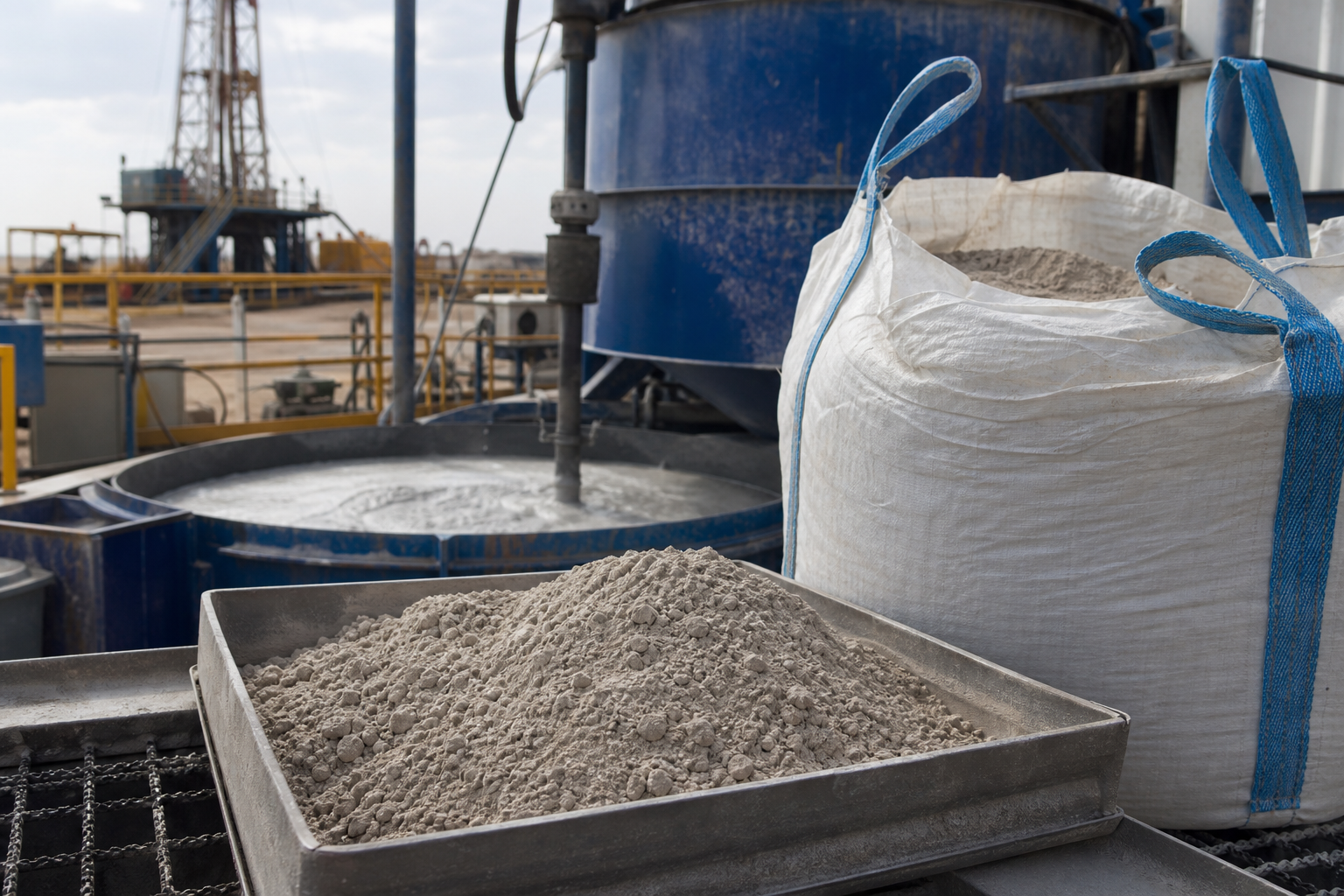
A purchase order that says only “barite powder” leaves too much open to interpretation. The mineral may be the same, but a drilling-fluid engineer and a coatings formulator judge it by very different criteria. A grade that performs well in a mud system is not automatically suitable for a white coating, and an ultra-fine bright filler is not automatically an API drilling product.
The practical difference is the job the powder must do
In drilling fluids, barite is a weighting material. Its main task is to add density without introducing excessive unwanted chemistry or an unsuitable particle-size profile. The buyer therefore looks first at specific gravity, API-related limits and consistency from lot to lot.
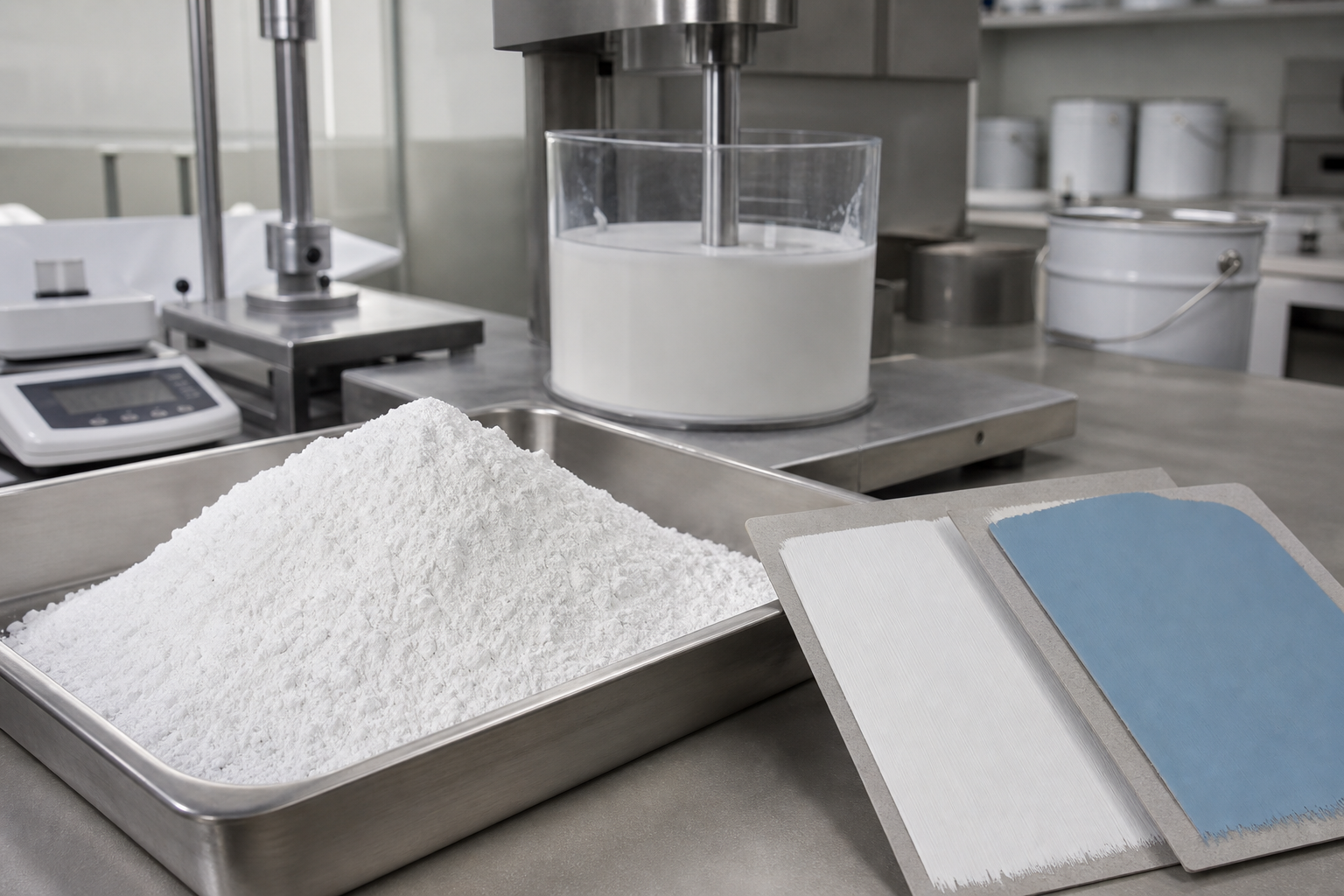
In industrial formulations, barite is a functional mineral filler or extender. It may contribute density, chemical resistance, dimensional stability, sound damping, surface finish or cost control. Here, brightness, colour tone, particle-size distribution, oil absorption, moisture and dispersion can matter as much as BaSO4 content.
What matters in API Drilling Grade Barite?
1. Specific gravity
Specific gravity is the commercial centre of a drilling-barite specification. A conventional API-grade product is commonly selected around a minimum specific gravity of 4.20, subject to the applicable API 13A edition and purchase agreement. Density below the agreed limit means more solid material may be needed to reach the same mud weight, with possible consequences for rheology and solids loading.
2. Particle-size distribution
Drilling barite must not contain excessive coarse particles that can settle or interfere with equipment, while an excessive ultrafine fraction can affect viscosity and fluid behaviour. Sieve residue and the fraction below the specified micron threshold are therefore operational parameters, not cosmetic numbers.
3. Soluble alkaline-earth metals
Soluble calcium and similar ions can interact with drilling-fluid chemistry. The relevant API test limits water-soluble alkaline-earth metals so the weighting agent does not create avoidable treatment problems in the mud system.
4. Moisture and batch consistency
Moisture affects flow, handling and the effective dry mass delivered. Buyers should request a current certificate of analysis and compare multiple lots, not rely only on a generic technical data sheet. Packaging integrity is especially important when material will sit in port storage or travel through humid routes.
5. Documentation and supply discipline
For a drilling project, a credible offer should identify the referenced standard, test method, typical or guaranteed values, packing, traceability and inspection terms. “High density” without a test basis is not a usable specification.
What matters in Industrial White Barite?
1. Whiteness and undertone
Premium White Barite is intended for applications that need a bright mineral filler. Even so, two powders with similar brightness readings can produce different visual results because undertone and contamination differ. Buyers should assess a representative sample in their own formulation rather than approve colour from a photograph.
2. Particle size, top cut and distribution
A median particle size alone does not describe the whole powder. The coarse tail can influence film smoothness and screen residue; the ultrafine fraction can change viscosity, surface area and binder demand. Ask for the measurement method and a distribution curve when the application is sensitive.
3. Oil absorption and dispersion
Oil absorption gives a practical indication of binder demand, although it should not replace a formulation trial. Stable dispersion, low grit and predictable viscosity are often more valuable to a coatings plant than a marginal increase in chemical purity.
4. Moisture and chemical cleanliness
Low moisture supports storage and feeding consistency. Chemical impurities can affect colour, corrosion behaviour or performance in demanding compounds. The acceptable limit depends on the resin, pigment package, process temperature and end-use requirement.
5. Surface treatment
Some polymer applications benefit from surface-treated barite to improve compatibility with the matrix. Treatment type and dosage should be agreed explicitly; treated and untreated products should never be treated as interchangeable.
Drilling barite and industrial barite compared
| Decision point | Drilling grade | Industrial grade |
|---|---|---|
| Primary function | Increase drilling-fluid density | Functional filler or extender |
| Leading property | Specific gravity and API compliance | Particle size, whiteness and formulation behaviour |
| Colour | Usually secondary | Often critical in coatings and polymers |
| Particle-size focus | Coarse residue and ultrafine limits relevant to mud performance | D50, top cut, distribution, grit and surface finish |
| Chemistry | Soluble alkaline-earth metals and agreed API parameters | BaSO4, impurities, moisture and application-specific limits |
| Approval method | Standard tests, COA and field/mud-system acceptance | Lab sample, formulation trial and finished-product evaluation |
How to write a useful purchase specification
For drilling barite, state the API 13A edition or customer method, minimum specific gravity, soluble alkaline-earth limit, particle-size limits, moisture, packing and inspection terms. For industrial barite, state the end use, colour requirement, particle-size method and targets, oil absorption where relevant, moisture, surface treatment, packing and sample-approval procedure.
The final step is commercial consistency. Agree which values are guaranteed, which are typical, how a non-conforming lot is handled and whether a pre-shipment sample or third-party inspection is required. That removes more risk than choosing a grade from a product name alone.
Need the right grade for your process?
Send us your target application, annual volume, required particle size and delivery destination. Our technical sales team will match the request to an appropriate barite grade and documentation package.
Request technical information