
 English
 Deutsch
 العربية
 فارسی
فارسی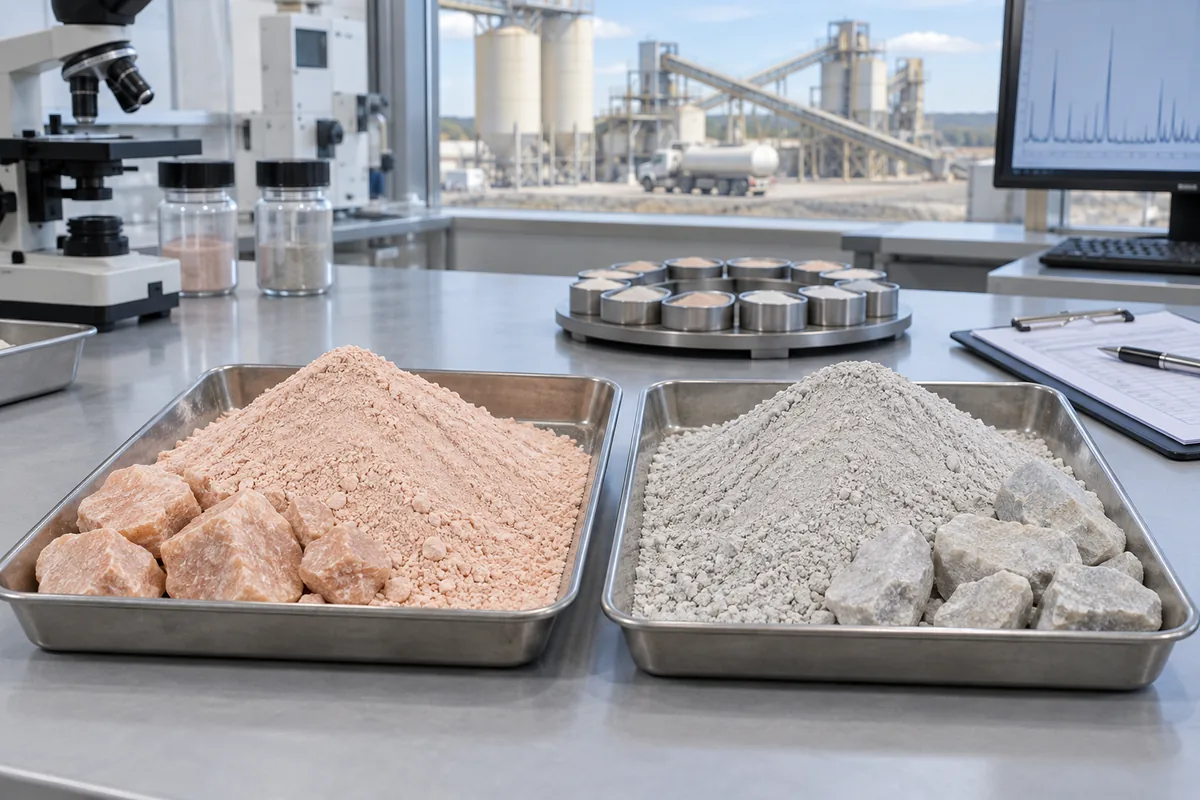
The short answer
Finding hematite or another iron-bearing mineral in natural barite does not by itself fail the material. A peach, pinkish or darker appearance is also not an automatic reason for rejection. A lot is accepted when it meets the agreed drilling-barite specification and its required laboratory tests.
It is important to separate two situations. Hematite may occur as an associated mineral in barite ore. Hematite can also be processed and supplied as a separate drilling-fluid weighting material. API Specification 13A and ISO 13500 treat barite and hematite as separate products.
Why can some barite look peach-coloured?
Natural barite is not always bright white. Its colour reflects the deposit and the associated minerals. In some deposits, a peach or pink tone can be linked to small amounts of iron oxides, including hematite. This is a reasonable explanation, but it is not a laboratory identification.
Colour cannot show which iron mineral is present or how much is present. XRF can report total iron, usually as an elemental or oxide value. XRD is the more useful test when the buyer needs to identify the mineral phase and confirm whether hematite is present.
Peach-coloured drilling barite can still be suitable. The relevant question is whether the supplied grade meets the agreed performance and acceptance requirements.
Does hematite automatically fail an API barite lot?
No. The presence of hematite is not, by itself, an automatic rejection rule for drilling barite. API/ISO acceptance of barite is based on the specified tests for the product. These cover matters such as density, water-soluble alkaline-earth metals and particle-size limits. The purchase order may also add customer-specific requirements.
A buyer should therefore avoid two shortcuts: a peach colour does not prove failure, and a high iron result alone does not prove that all the iron is hematite. The complete report, test methods and intended mud system should be considered together.
For the product specification, see KANIPER API drilling barite. The difference between the two recognized density grades is explained in barite specific gravity 4.2 versus 4.1.
What should a buyer check?
| Observation | What it may mean | Useful next check |
|---|---|---|
| Peach or pink colour | Iron oxides may be associated with the natural deposit | Review the COA; request XRD if mineral identity matters |
| Iron reported by XRF | Iron is present, but its mineral form is not confirmed | Use XRD or an agreed mineralogical method |
| Density meets the order | One key drilling-barite requirement is satisfied | Check the remaining API/ISO parameters |
| Concern about wear or mud behaviour | Mineralogy and particle size may need closer review | Run the agreed abrasion or application test |
Simple purchasing checklist
- State the required API/ISO grade and edition in the purchase order.
- Agree the acceptance tests before shipment.
- Review density, soluble alkaline-earth metals and particle-size results.
- Do not use colour as the only acceptance criterion.
- Request XRF for elemental composition when required.
- Request XRD when the identity of an iron-bearing mineral matters.
- Approve a representative sample if the mud system has special limits.
For a broader comparison, read drilling barite versus industrial barite. To discuss a peach-coloured or other drilling-barite grade, contact the KANIPER team.
References
- ISO 13500:2008, Petroleum and natural gas industries — Drilling fluid materials — Specifications and tests.
- American Petroleum Institute, API Specification 13A, Drilling Fluid Materials.
- SLB Energy Glossary, entries for weight material, hematite and iron oxide.
Need to evaluate a drilling-barite sample?
Send the required standard, test report, quantity and destination. KANIPER can discuss the suitable drilling-barite option for your order.
Contact KANIPER