
 English
 Deutsch
 العربية
 فارسی
فارسی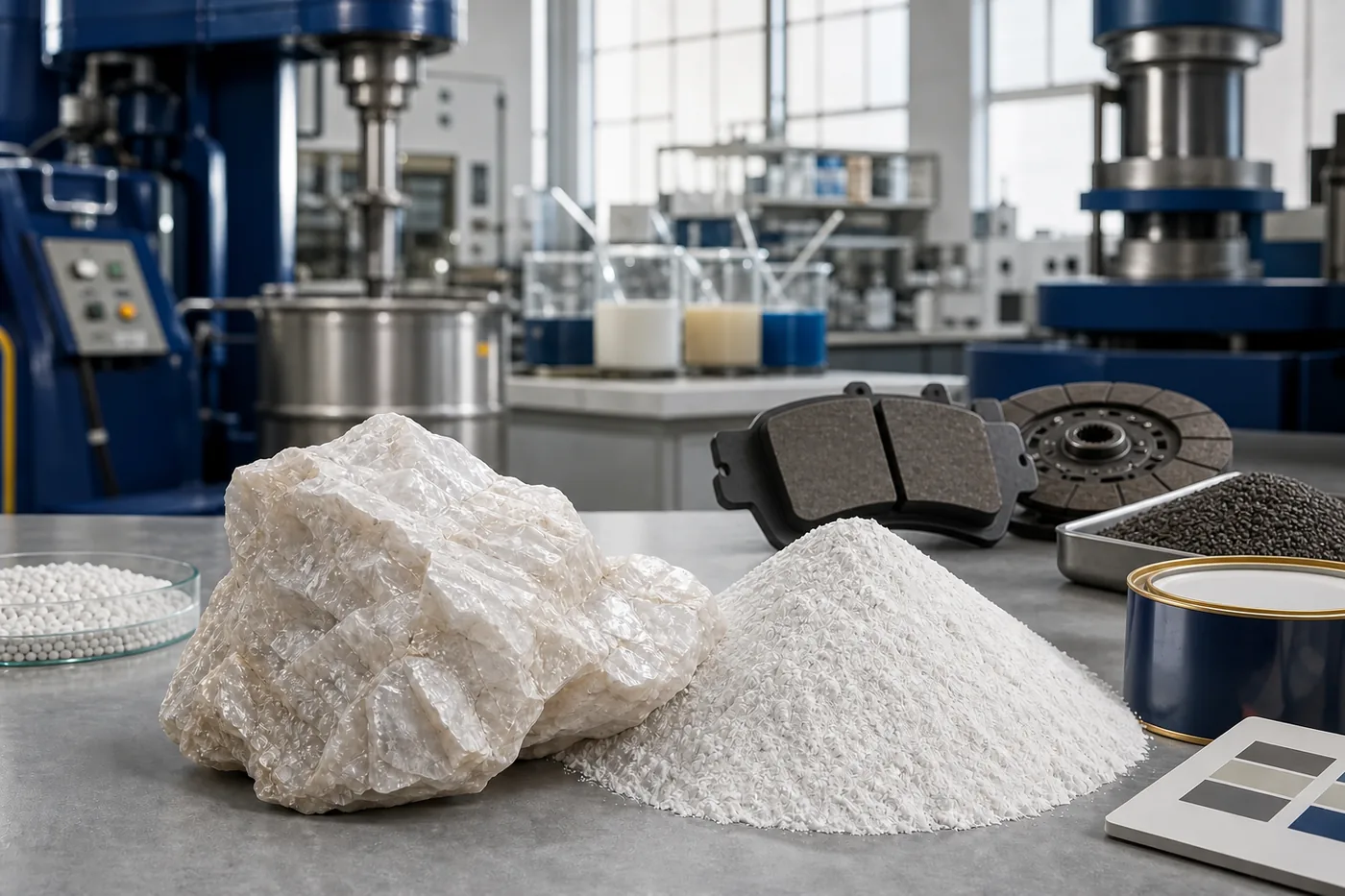
Barite in simple terms
Barite, also written baryte, is the mineral form of barium sulfate (BaSO4). It feels unusually heavy for a non-metallic mineral. Most commercial barite is crushed, upgraded when necessary and ground into a controlled powder.
Why is barite useful?
Barite combines high specific gravity with low hardness and good chemical stability. It is also insoluble in water under normal conditions. The value of a grade still depends on its density, purity, colour, particle-size distribution, moisture and consistency.
Where is barite used?
Drilling fluids
API Drilling Grade Barite is used to increase drilling-fluid density and help control formation pressure. Density, particle size and soluble contaminants are central purchase criteria.
Paints, plastics and rubber
Industrial White Barite is used as a functional mineral filler. It can add density, improve dimensional stability and support surface and processing properties. Bright formulations may require Premium White Barite.
Friction materials and other applications
Barite is used as a mineral filler in brake linings, clutch facings and other friction compounds. It is also used in sound-damping materials and as a raw material for barium chemicals. Each application needs its own specification.
How should buyers choose a grade?
| Application | Important checks |
|---|---|
| Drilling | Specific gravity, API requirements, particle size and soluble contaminants |
| Paint and plastics | Whiteness, undertone, particle distribution, oil absorption and dispersion |
| Brake linings and friction materials | Particle size, purity, moisture, dispersion and batch consistency |
Start with the final use, not only a purity number. Review a representative sample, the technical data sheet and the certificate of analysis for the shipment. For a direct comparison, see Drilling Barite vs Industrial Barite.
Which barite grade fits your application?
Send us your application, required particle size, annual quantity and delivery destination.
Request technical information