
 English
 Deutsch
 العربية
 فارسی
فارسی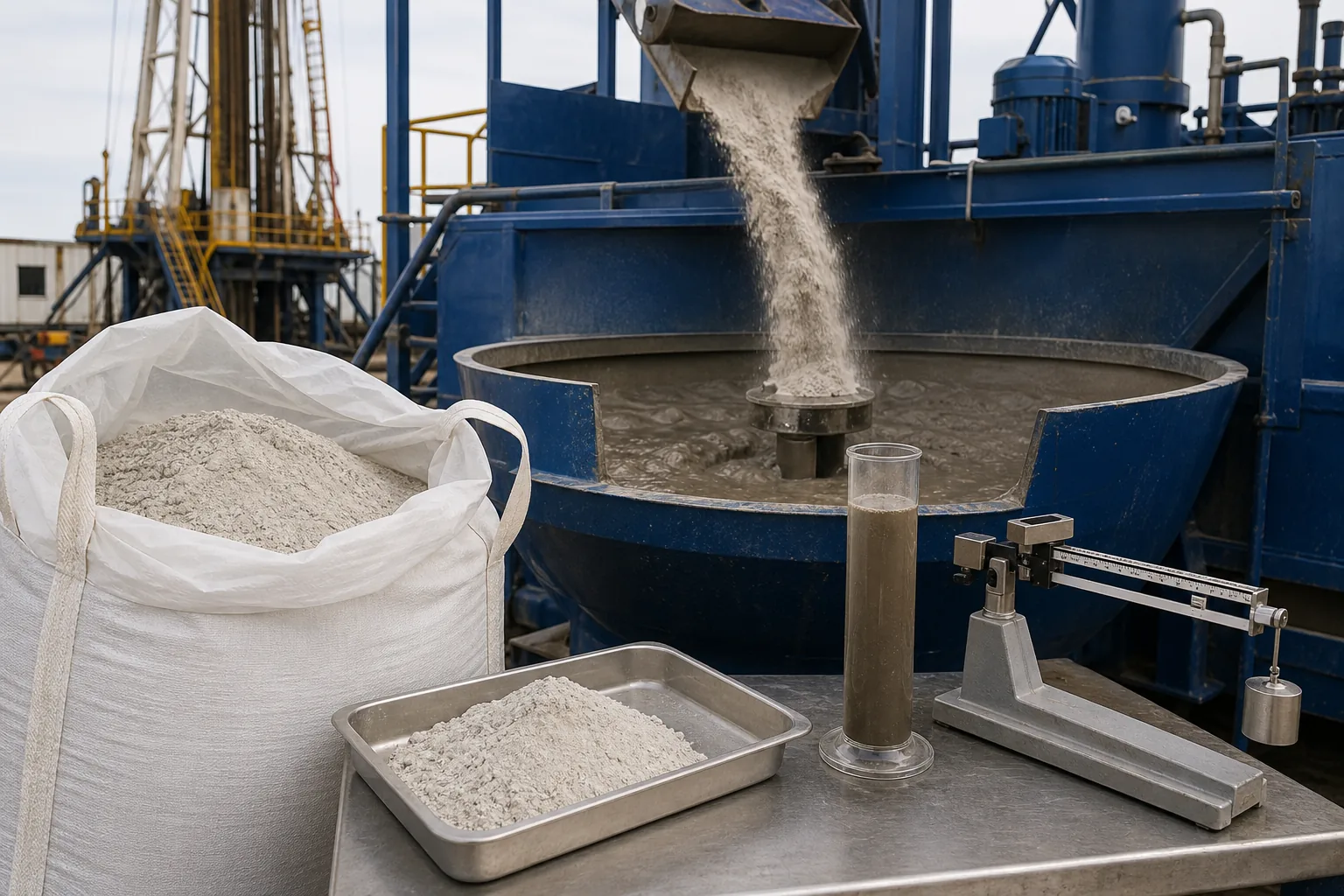
The short answer
Drilling mud must create enough hydrostatic pressure to balance pressure in the rock formation. API drilling-grade barite is added when the fluid needs more weight. It increases density while remaining relatively soft, chemically stable and practically insoluble in water.
Barite does not replace the whole mud system. It is the weighting material inside a formulation that may also contain clays, polymers, salts and fluid-loss additives.
What does barite do in a drilling fluid?
1. Raises mud density
Ground barite adds mass to the circulating fluid. Engineers adjust the concentration to reach the required mud weight. The target depends on formation pressure, well geometry and the operating programme.
2. Supports pressure control
A correctly weighted fluid helps balance formation pressure. Too little density can increase well-control risk. Excessive density can raise equivalent circulating density, increase losses and add unnecessary solids.
3. Remains usable in circulation
Barite is dense but comparatively soft. Its low solubility and chemical stability help it work in many water-based and oil-based systems. Particle-size control is still essential because coarse particles can settle and very fine material can affect rheology.
Why is barite preferred?
| Property | Practical value in drilling mud | What the buyer should verify |
|---|---|---|
| High specific gravity | Adds density with less volume than ordinary mineral fillers | Test method, declared grade and shipment consistency |
| Low hardness | Limits abrasive wear compared with harder weighting minerals | Mineralogy and coarse residue |
| Low solubility | Helps preserve the planned fluid chemistry | Water-soluble alkaline-earth metals |
| Controlled particle size | Supports suspension, pumping and solids control | Residue, distribution and oversize particles |
API 4.2 and 4.1 grades
Buyers may encounter drilling barite identified by minimum specific gravity. The number alone is not a complete specification. Density, particle size, soluble contaminants and the applicable edition of the purchasing standard must be stated together. For grade differences, read Drilling Barite vs Industrial Barite.
Procurement checklist
- State the required API or customer specification and its edition.
- Confirm the specific-gravity test method and acceptance limit.
- Review particle-size or residue results, not only a mesh label.
- Check soluble alkaline-earth metals and other required contaminants.
- Request a representative sample before bulk approval.
- Compare the sample, TDS and shipment COA using the same methods.
- Agree packaging, moisture protection, lot identification and delivery terms.
For the available product data, see the KANIPER API Barite technical data sheet. A broader introduction is available in What Is Barite?.
Need a drilling-barite specification or sample?
Send the required standard, target specific gravity, quantity and delivery destination.
Request technical information