
 English
 Deutsch
 العربية
 فارسی
فارسی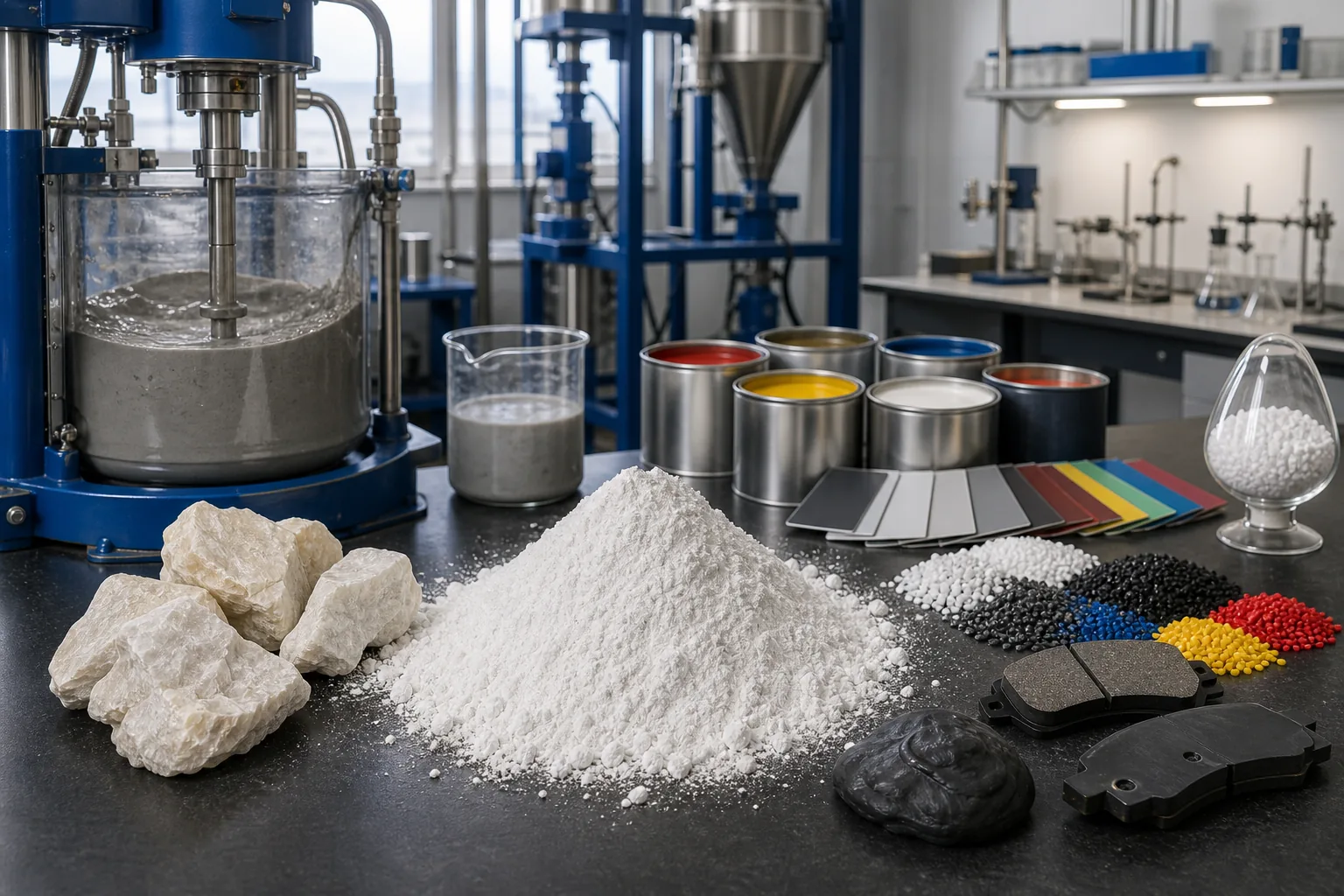
The quick answer
Most barite is ground before use. In oil and gas drilling, it works as a weighting material. In industrial formulations, it can act as a filler, extender or density modifier. Common applications include paints, coatings, plastics, masterbatch, rubber, brake pads and clutch materials.
One powder cannot serve every market equally well. API drilling-grade barite is selected mainly for density and drilling-fluid compliance. industrial white barite is chosen for particle size, colour, dispersion and formulation performance. Applications with demanding visual requirements may need premium white barite.
Main uses of barite powder
1. Drilling fluids
Barite raises drilling-fluid density. The added hydrostatic pressure helps balance formation pressure. Buyers should define the applicable drilling specification, minimum specific gravity, particle-size limits and soluble contaminants. More detail is available in Why Is Barite Used in Drilling Mud?.
2. Paints and coatings
In coatings, barite can add body, support film hardness and help control gloss and density. White or micronized grades are normally more relevant than drilling grades. Whiteness, undertone, oil absorption, fineness, coarse residue and dispersion should be tested in the actual formulation.
3. Plastics and masterbatch
Barite is used when a polymer compound needs higher density, dimensional stability or a smooth mineral-filled appearance. The processor must check moisture, particle-size distribution, dispersion and compatibility with the resin. A mesh number alone does not predict processing behaviour.
4. Rubber products
Barite can increase density and serve as a mineral filler in selected rubber compounds. The useful grade depends on hardness, abrasion requirements, mixing behaviour and the final part. Consistency between lots matters because changes in fine particles can affect viscosity and processing.
5. Brake pads and friction materials
Barite is used as one component in some brake-pad, clutch and friction formulations. It contributes density and mineral content, but it does not determine performance alone. The complete formulation must be tested for friction stability, wear, noise and temperature behaviour.
6. Other specialised applications
Barite is also reported in mould-release compounds, selected paper products and high-density systems. These uses need application-specific approval. Pharmaceutical barium sulfate is a separate, highly controlled product and must not be confused with ordinary industrial barite.
Which grade fits each application?
| Application | Primary function | Important checks | Likely KANIPER grade |
|---|---|---|---|
| Drilling fluid | Weighting material | Specific gravity, residue, fine fraction, soluble contaminants | API Barite |
| Industrial paint | Functional filler and density control | Whiteness, undertone, particle size, oil absorption, dispersion | Industrial White Barite |
| Decorative or light-coloured coating | Filler with controlled visual effect | High whiteness, colour consistency, coarse residue, surface finish | Premium White Barite |
| Plastic or masterbatch | Density and dimensional stability | Particle distribution, moisture, dispersion, processing trial | Industrial or premium white grade |
| Rubber and friction material | Mineral filler and density | Particle size, chemistry, lot consistency, compound testing | Application-approved industrial grade |
Why particle size matters
Two powders sold under the same mesh label can behave differently. A useful specification includes the measurement method, coarse residue and distribution data where needed. Fine material can change viscosity and surface area. Oversize particles can affect finish, screens and wear.
Natural barite is not synthetic barium sulfate
Ground natural barite and precipitated barium sulfate are different commercial products. Synthetic material can offer tightly controlled purity and particle properties, but it usually serves different technical and economic decisions. The buyer should state which material is required instead of using the names interchangeably.
Buyer checklist before ordering
- Define the application and the function expected from barite.
- State the test method for each acceptance value.
- Review particle-size distribution, not only mesh.
- For light-coloured products, approve whiteness and undertone in the real formulation.
- Check moisture, chemistry and coarse residue.
- Test a representative sample before bulk purchase.
- Match the sample, TDS and shipment COA to the same grade.
- Agree packaging, lot identification and delivery terms.
For a basic mineral overview, see What Is Barite?. For a direct grade comparison, read Drilling Barite vs Industrial Barite.
Need help selecting a barite grade?
Tell us the application, target particle size, required documents, quantity and destination.
Request technical information